

The Champion Trap
Why the person most eager to help you is the wrong person to build with

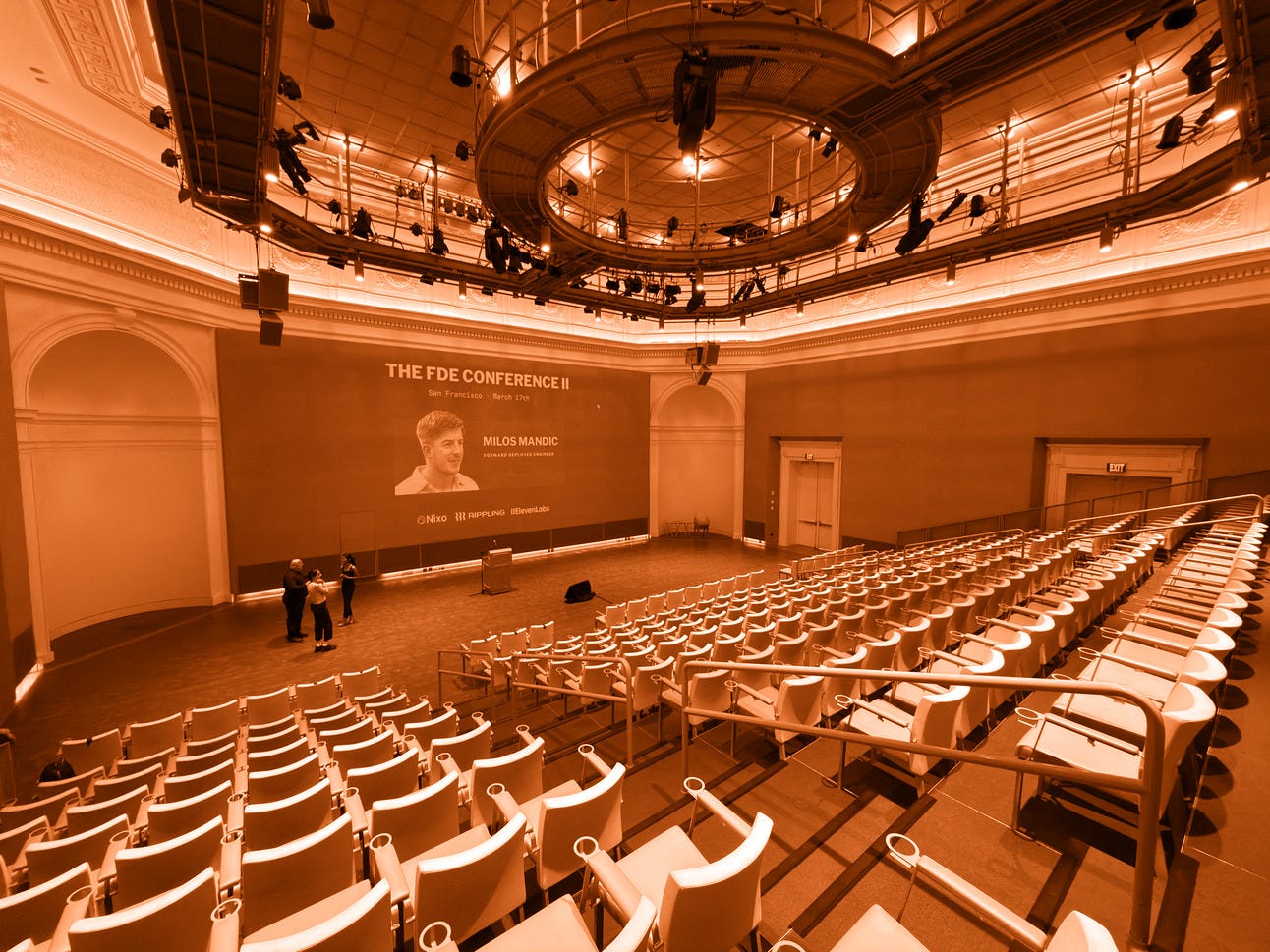
You might have noticed I went quiet for almost ten days. I spent a few days in San Francisco, attending meetings and delivering a talk at the FDE Conference, organised by Nixo, Rippling and ElevenLabs. Between the travel and the talk prep, I decided to skip a week rather than rush something out.
This week, I want to share what I talked about. The talk was called “The Champion Trap,” and it’s based on a pattern I’ve seen across roughly 20 client engagements so far. The pattern is simple: the person most excited to work with you is often the one most likely to send you in the wrong direction.
That sounds ungrateful. It’s not meant to be. The champion is usually someone incredible. But there’s a gap between knowing what a team does and knowing why they do it the way they do it. And that gap will cost you months if you don’t catch it early.
Let me walk you through how I learned this.
The setup
Global customer. A major music label with offices across the UK, US, and the Netherlands. The project: accounts payable automation.
On paper, accounts payable doesn’t sound too complicated. But their suppliers are music artists, and artists are not always comfortable with invoicing. Formats ranged from proper PDFs to handwritten notes, Word documents, Excel files, things that barely qualified as invoices at all. Tens of thousands of suppliers. 150 possible approval paths across seven levels of hierarchy.
One invoice sticks with me. We flagged it for a missing purchase order number. The operator reached out to the creditor and asked them to add it. They sent back a revised invoice. We processed it, flagged it again. The purchase order was still missing. I double-checked. They had literally typed the words “purchase order” on the invoice instead of providing the actual number.
That’s the kind of territory we were operating in.
We had a champion on the client side, and she was excellent. This project was her top priority. She was available, responsive, senior enough to make decisions, and deeply motivated to get it done. Every instinct said: this is the person to build with. This is the person who’s going to get us to a solution fastest.
We spent two months building the solution with her.
Death by a thousand details
Then we gave it to the operators.
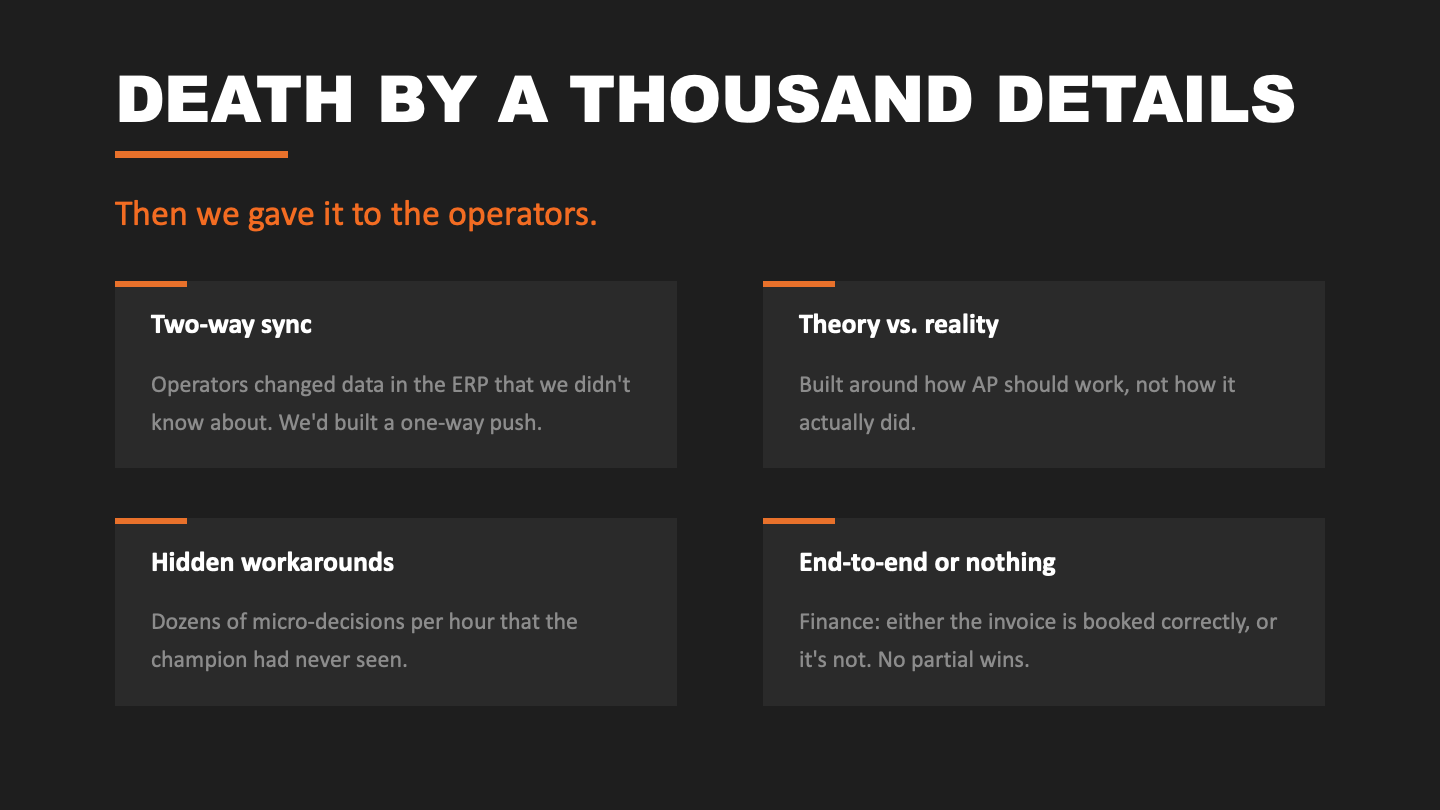
It wasn’t one big dramatic failure. It was dozens of small things. Operators were changing data directly in the ERP that we didn’t know about, which meant we needed two-way sync instead of the one-way push we’d built. The approval process ran on a spreadsheet that had been growing for over a decade, with paths and exceptions nobody had fully documented. We’d built around how accounts payable should work, not how it actually did.
There were hidden workarounds everywhere. Dozens of micro-decisions per hour that the champion had never seen, because she didn’t do this work every day. The operators did.
And because this was finance, there was no room for partial wins. Either the invoice books correctly, or it doesn’t. There’s no “almost right” in AP.
The champion wasn’t wrong about anything. She genuinely believed she knew how the process worked. But there’s a difference between overseeing a process and living inside it, eight hours a day, handling the exceptions and edge cases that never make it into a summary.
The cost
Two to three months of redesign. The AI worked fine. We’d just built with the wrong person’s understanding.
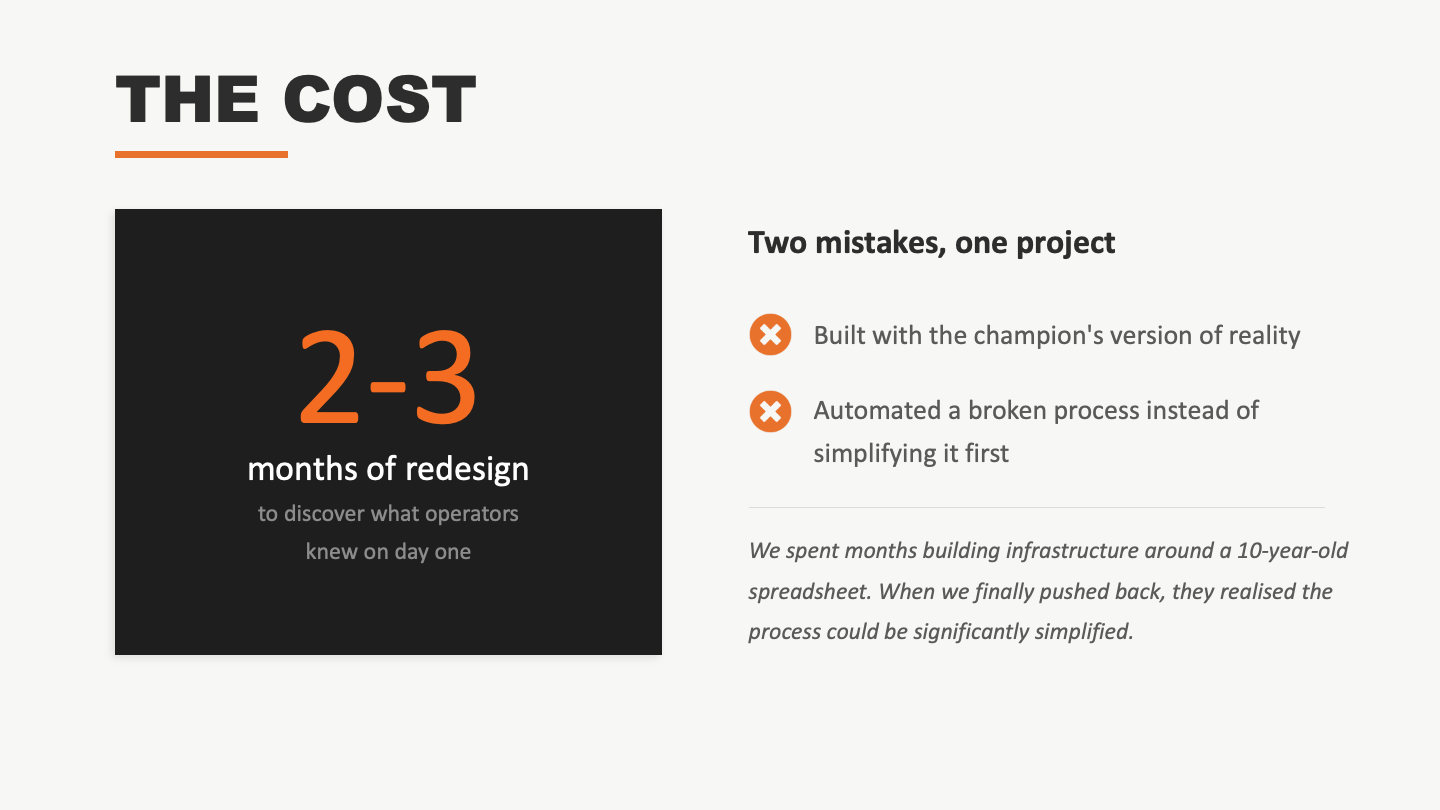
Two mistakes in one project. First, we built with the champion’s version of reality instead of the operator’s. Second, we tried to automate a broken process instead of simplifying it first.
We spent months building infrastructure around that ten-year-old approval spreadsheet, faithfully replicating every path and exception. When we finally pushed back and said this is going to take longer and be harder to maintain if we cover every path, they realised the process could be significantly simplified. The framing that unlocked it: faster delivery, easier maintenance. Everyone wants both.
The project is in a much better place now. But those extra months were the tuition fee for a lesson I won’t forget.
Right customer, right stage
Four people matter in every FDE project: the sponsor, the champion, the operator, and the FDE. Each one is essential, but at different stages.
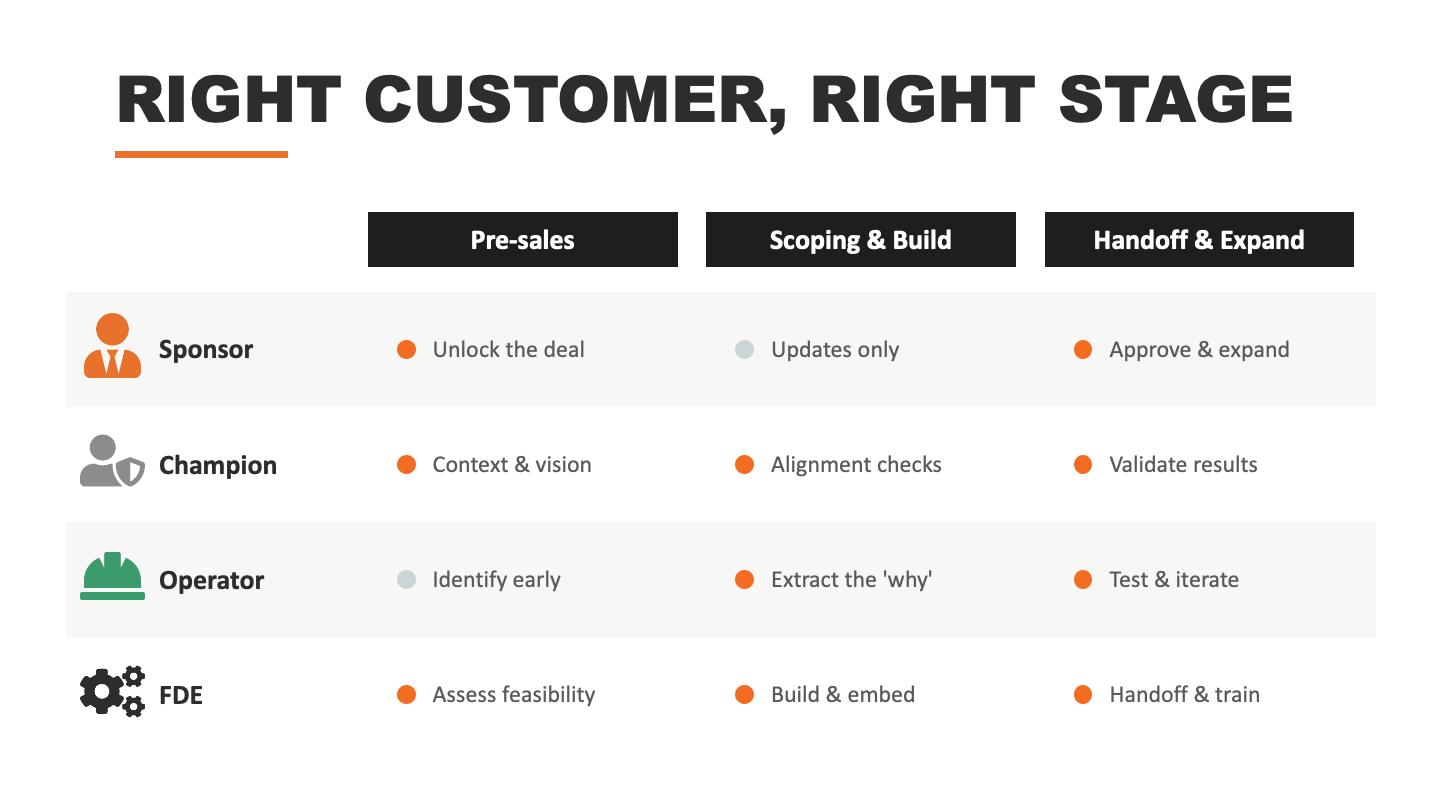
The sponsor unlocks the deal in pre-sales and approves expansion at the end. During the build, they just need updates.
The champion gives you context and vision. They’re invaluable during pre-sales and for alignment checks throughout. But their role during the build itself should be periodic check-ins, not daily collaboration.
The operator is where the real knowledge lives. They should be your primary partner during scoping and the build phase. They hold the “why” behind every workaround, every exception, every process that looks irrational from the outside but makes perfect sense when you understand the constraints.
Champions know what the team does. Operators know why they do it the way they do it. If you only have the “what,” you’ll build something that looks right but doesn’t work in practice.
What it looks like done right
Different project, different client, different approach. Sales order processing.
This time, we pushed hard from the very first call to get connected with the operators. Before the deal closed, before scoping was even finished. We did a thorough discovery call where we actually mapped the process before signing anything. At kickoff, we confirmed everything with operators from day one. No assumptions from the sales phase carried over unchecked.
Then we built fast, iterated with operators synchronously and intensely, and delivered in six weeks from first contact.
The difference wasn’t that we built faster. It’s that we knew who to sit with from the start.
This part is worth being honest about: operators are not always eager to work with you. There’s real fear around AI. People wonder if you’re there to replace them, restructure their role, or hand their job to a machine. I’ve been fortunate that in almost every engagement I’ve worked on, the company’s intention has been to free operators from repetitive work and give them more meaningful things to do. But the operators don’t always know that when you first walk in. Earning their trust, warming them up enough to share how the work really gets done, that’s part of the job. Maybe the most important part.
The closing thought
This matters more now than ever. AI is getting better at the intelligence layer. It can process invoices, route approvals, handle data entry. But the “why,” the judgment, the decision-making, that still lives with the people doing the work every day. And the only way to get it is to be in the room with the people doing the work. With them.
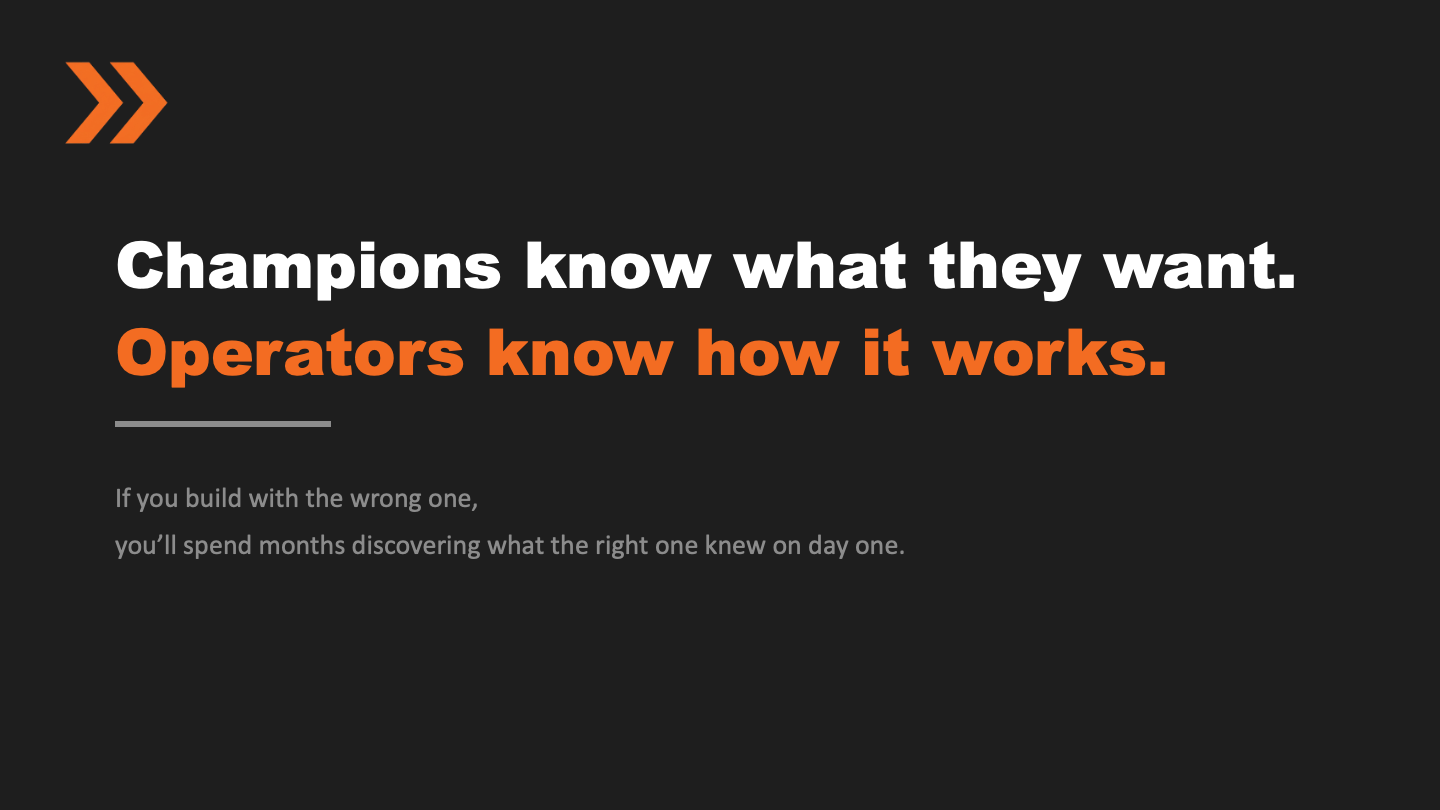
Every project has someone eager to help you build. The hard part is finding who knows how the work gets done.
The value of an FDE isn’t building faster. Tools are making building easier every month. The value is knowing who to sit with. And it’s almost never the person raising their hand.
Great insights and analysis!
Incredibly insightful! I’m currently working in post-sales implementation, not quite FDE but pretty close and I’ve 100% found the same thing. Working with the champion is never the right answer when you’re finally trying to implement the product, you need to be talking to the people on the ground doing the actual work.