

The State of Forward Deployed Engineering: 2025
What 2,000 profiles reveal about the role

I recently got access to a dataset of nearly 2,000 FDE profiles compiled from public LinkedIn data. It’s the most comprehensive picture of the FDE landscape I’ve seen.
I spent the past week analysing it. Here’s what I found.

The Numbers
The dataset contains 1,982 people who currently hold FDE titles across 776 different companies. That second number surprised me. I knew the role was spreading beyond Palantir, but I didn’t expect to find it at nearly 800 organisations.
The average FDE in this dataset has 11.7 years of professional experience. The median is 9.8 years. These are not junior engineers learning the ropes. These are people with a decade of experience who’ve chosen this particular path.
Before I go further, a note on methodology. This data was compiled from public profiles, which means it captures what people chose to share. When I say “46% of FDEs list Python as a primary language,” I mean 46% of FDEs in this dataset had Python listed on their profile. Absence of data doesn’t mean absence of the thing itself.
With that caveat, let’s dig in.
The Company Landscape
If you’ve heard of the FDE role, you’ve probably heard of it through Palantir. The data confirms why.
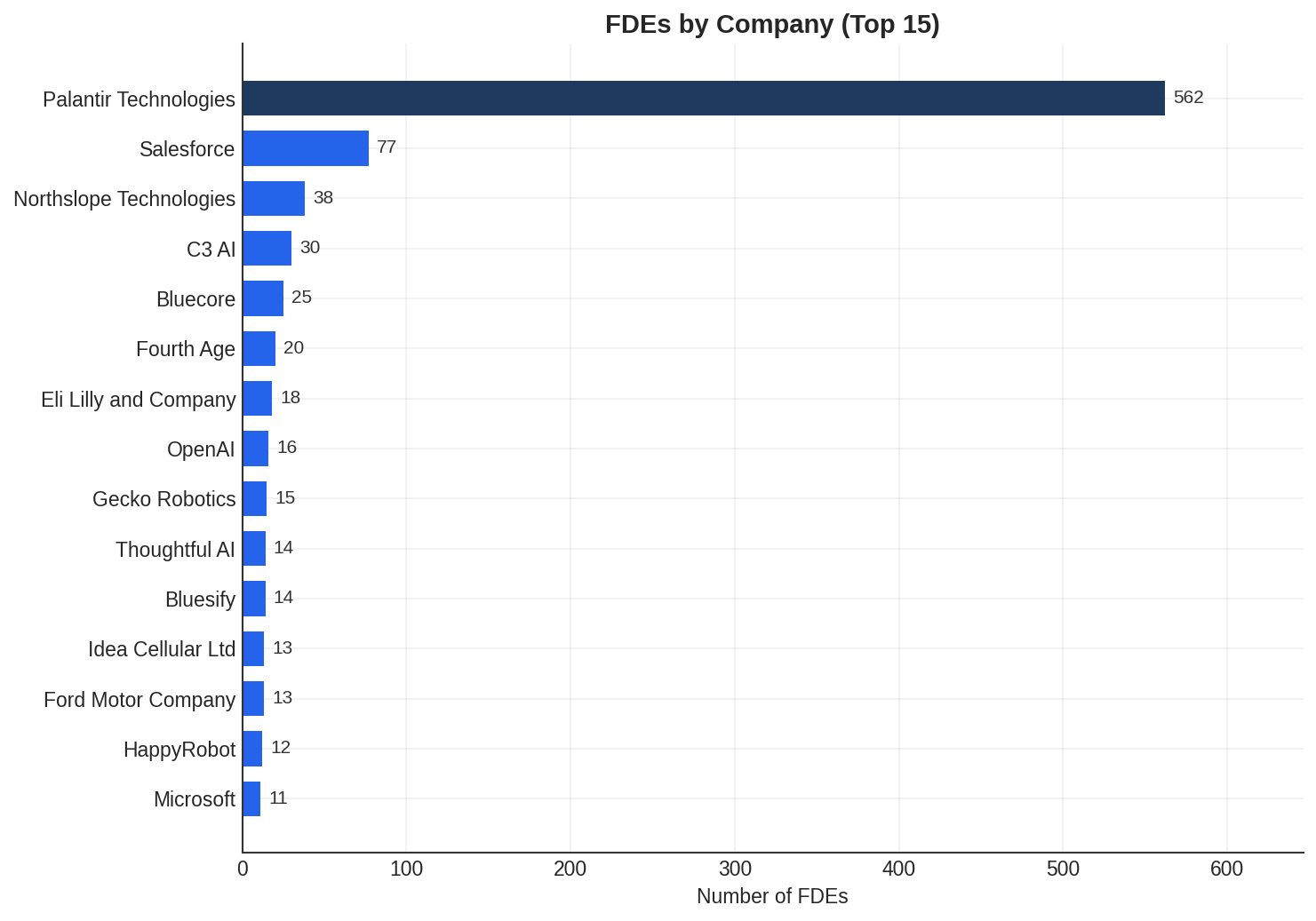
Palantir employs 562 FDEs in this dataset. That’s 28% of all FDEs. The next largest employer is Salesforce with 77. Palantir is 7.3 times larger than the second-place company.
This isn’t just historical accident. Palantir essentially invented the modern FDE role and has been refining it for over a decade. They’ve created a playbook that others are now copying.
The interesting story is what happens after Palantir. The next tier includes Salesforce (77), Northslope Technologies (38), C3 AI (30), Bluecore (25), and a mix of AI startups and traditional enterprises. OpenAI appears with 16 FDEs. Microsoft has 11. Scale AI has 10.
What caught my attention was seeing non-tech companies in the list. Eli Lilly has 18 FDEs. Ford has 13. The role is no longer confined to software companies selling to enterprises. Enterprises themselves are building FDE teams.
Experience Levels
One of the most persistent misconceptions about the FDE role is that it’s a junior position. Something between an internship and a “real” engineering job. The data says otherwise.
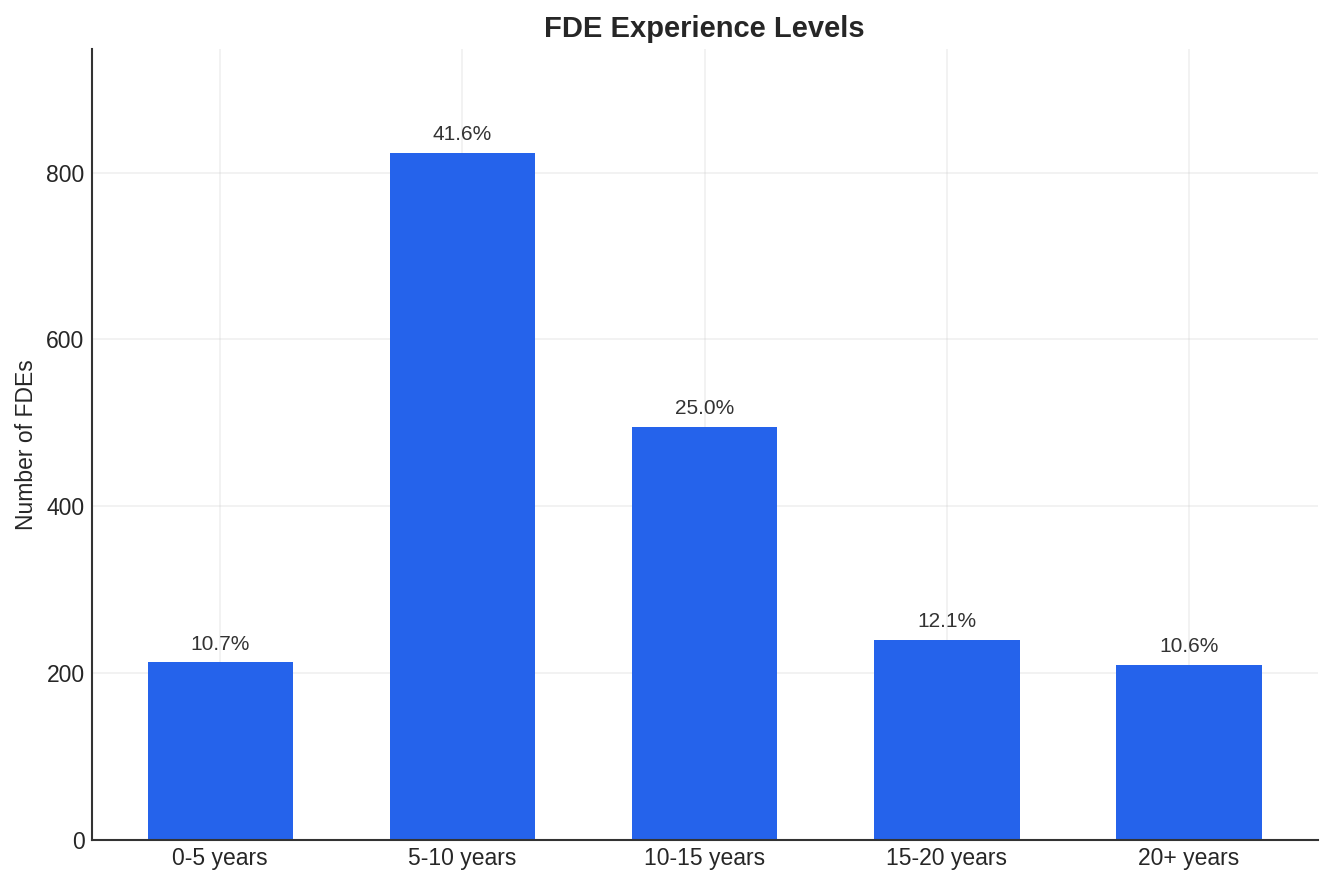
Only 10.7% of FDEs have less than five years of experience. The largest cohort, at 41.6%, has between five and ten years. A quarter have between ten and fifteen years. And 22.7% have more than fifteen years of experience, including over 200 FDEs with more than twenty years in the industry.
The median experience of 9.8 years tells the story. This is a mid-to-senior career role. You’re not typically hired as an FDE straight out of university. You’re hired because you’ve accumulated enough technical depth and business acumen to operate effectively in ambiguous client environments.
There’s an interesting split when you compare Palantir to the rest of the market. Palantir FDEs average 9.8 years of experience. Non-Palantir FDEs average 12.4 years. This makes sense. Palantir has a well-oiled machine for developing FDEs internally. Other companies are more likely to hire experienced engineers who can hit the ground running.
Where FDEs Work
The FDE role is heavily concentrated in the United States, but less so than I expected.
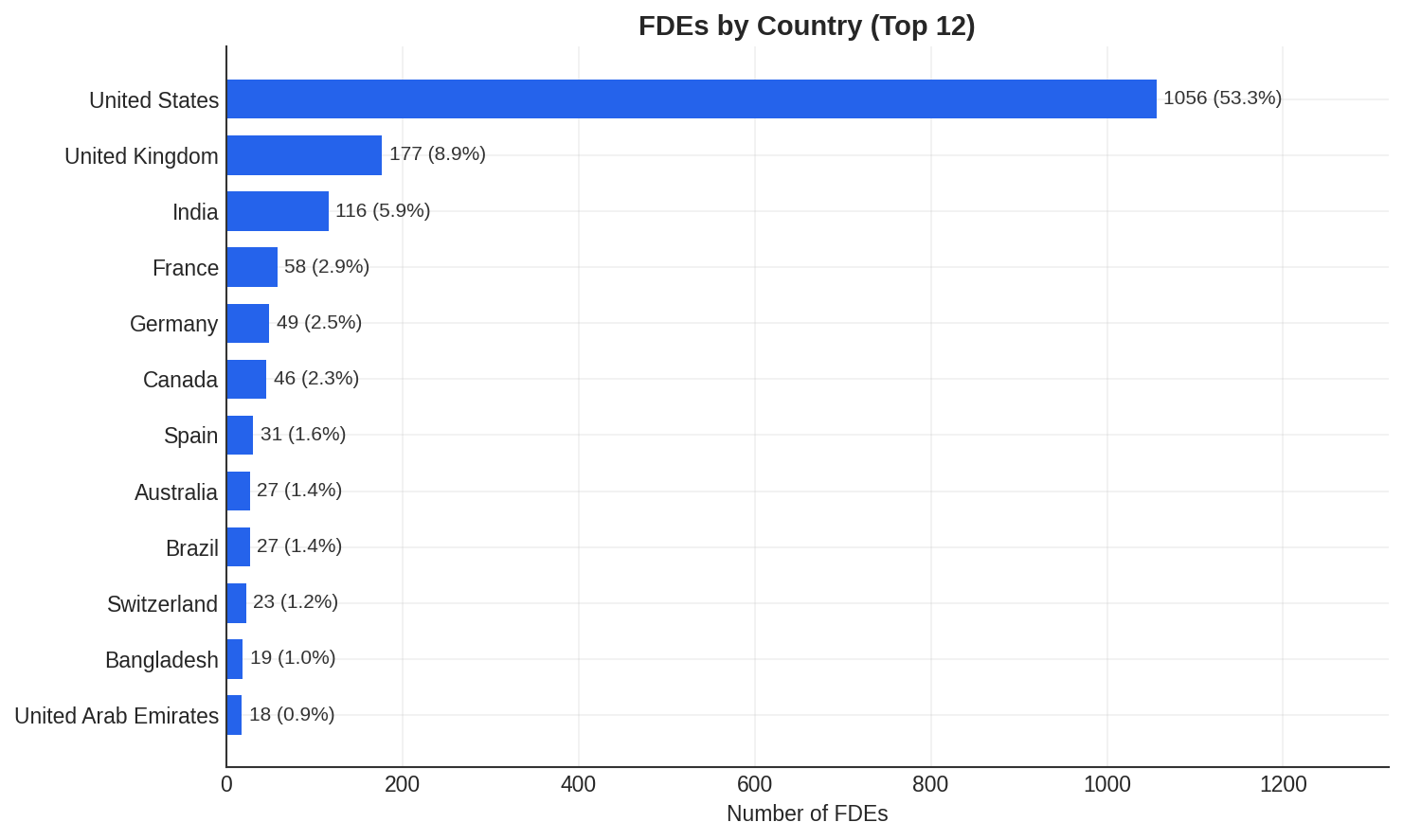
Just over half (53%) of FDEs are US-based. The UK comes second with nearly 9%, followed by India at 6%. When you add up Western Europe (UK, France, Germany, Spain, Switzerland, Netherlands), you get about 17% of the global FDE population.
The city-level data is more concentrated. New York is the FDE capital with roughly 280 FDEs when you combine Manhattan, Brooklyn, and the metro area. London is second with 128. San Francisco and the Bay Area together account for around 120. Washington DC has a notable cluster, likely driven by Palantir’s government work.
Palantir’s geographic distribution skews even more American than the overall market. About 65% of Palantir FDEs are US-based, compared to 53% overall. Their second-largest hub is the UK at 15.5%.
The Technical Profile
What technologies do FDEs actually work with? The data paints a picture of generalists rather than specialists.
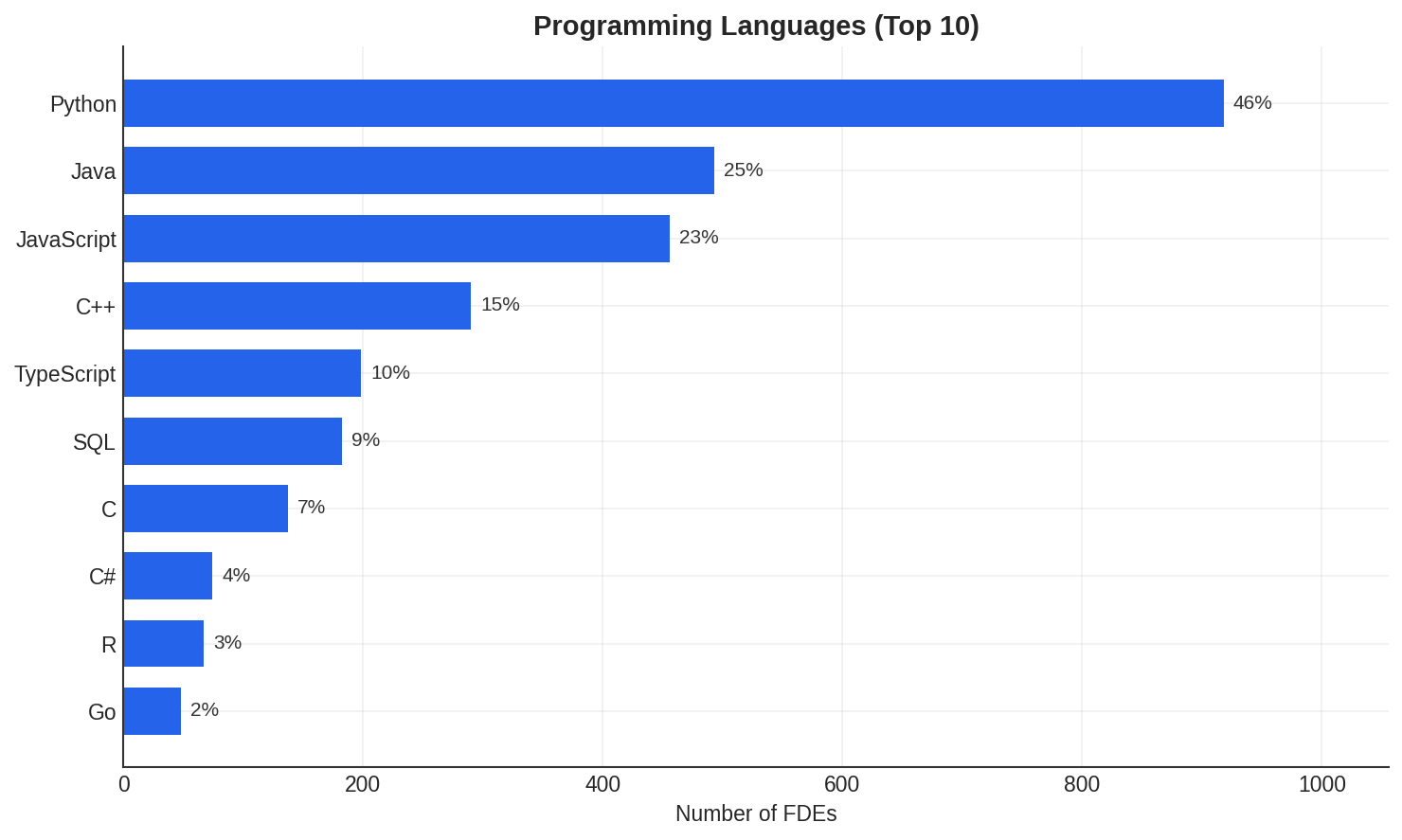
Python dominates. 46% of FDEs list it as a primary programming language. Java comes second at 25%, followed by JavaScript at 23%. The drop-off after the top three is significant. TypeScript appears at 10%, C++ at 15%, SQL at 9%.
The technology stack data tells a similar story. Beyond programming languages, the most common technologies are AWS (10%), React (9%), Node.js (9%), and Docker (9%). There’s no single dominant framework or platform. FDEs need to be comfortable picking up whatever the client environment requires.
This generalist profile makes sense given the nature of the work. You’re not building products in a controlled environment. You’re deploying solutions into existing enterprise systems with their own tech stacks, legacy constraints, and integration requirements. Depth in one technology matters less than breadth across many.
Market Structure
The FDE market has an unusual structure. It’s simultaneously concentrated and fragmented.
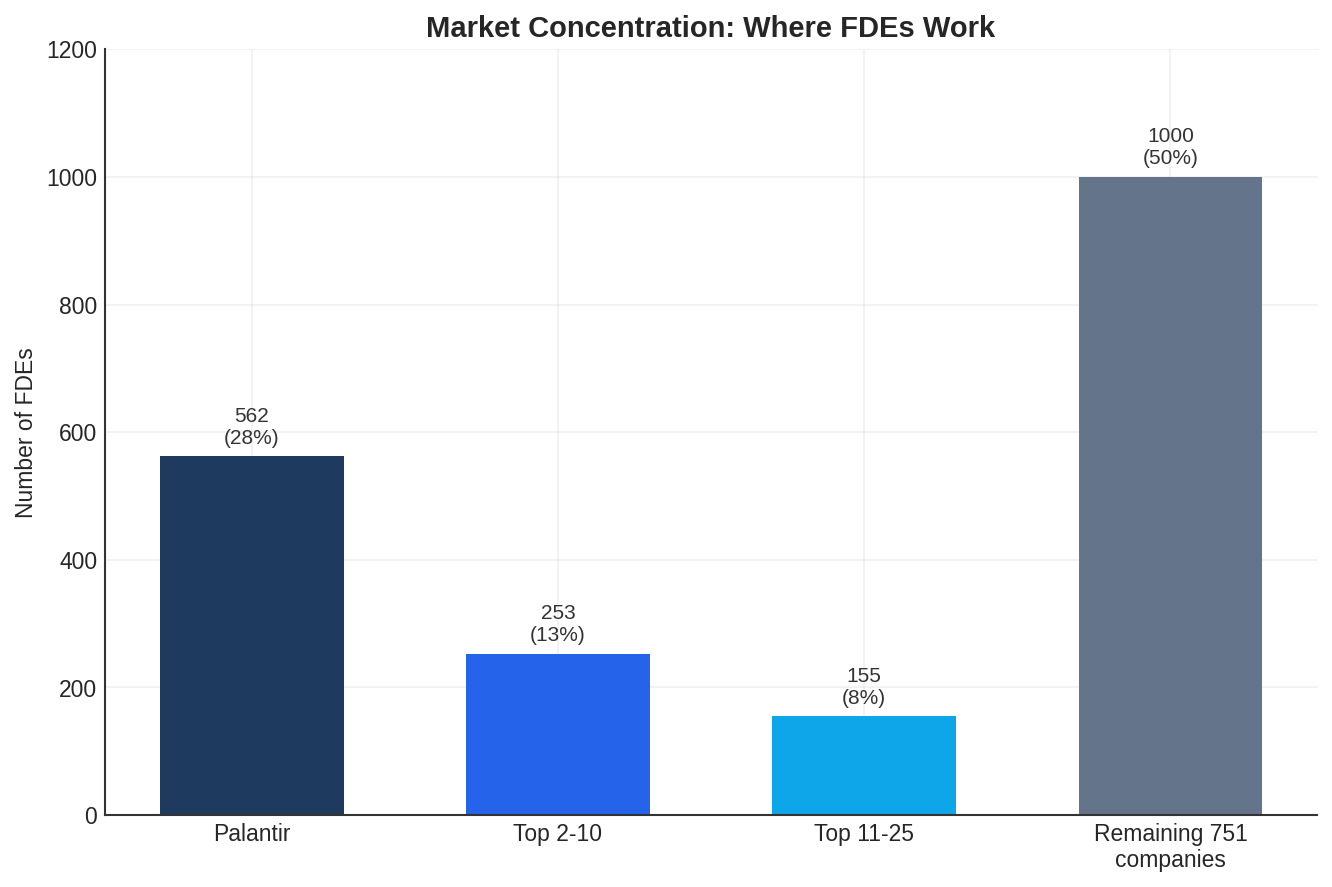
At the top, you have Palantir with 28% of all FDEs. The next nine companies (Salesforce through Thoughtful AI) account for another 13%. The following fifteen companies add 8% more. That’s roughly half of all FDEs at just 25 companies.
The other half work at 751 different companies. And of those 751 companies, 625 have exactly one FDE.
This creates two distinct FDE experiences. At Palantir or Salesforce, you’re part of an established team with defined processes, career ladders, and internal mobility. You work alongside other FDEs who understand your challenges.
At a startup with a single FDE, you’re defining the role as you go. There’s no playbook to follow. No senior FDE to learn from. The 625 “solo FDEs” in this dataset average 13.6 years of experience, higher than the overall average. Companies hiring their first FDE tend to look for someone senior enough to figure it out independently.
Career Paths
Where do FDEs come from? The previous-company data offers some clues.
The most common prior employer is Palantir itself (41 people). This represents FDEs who left Palantir and took the role elsewhere. Microsoft (20), Google (17), and Amazon (17) are the next most common. The consulting world is represented too, with Accenture (12), Booz Allen Hamilton (6), and various McKinsey-adjacent firms appearing.
The educational background is heavily technical. Computer Science dominates with 418 FDEs listing it as their field of study. But you also find Mechanical Engineering (36), Physics (15), Economics (12), and other quantitative fields. The role rewards analytical thinking regardless of the specific technical domain.
A small but notable group has “Founding FDE” or similar titles. These 20 people were explicitly hired as the first FDE at their company. They’re building the function from scratch at startups like Retell AI, StackAI, and Maven AGI.
What This Means
A few observations from sitting with this data.
The FDE role is real and growing. Nearly 800 companies have adopted some version of it. It’s no longer a Palantir quirk. It’s becoming a standard part of how AI and enterprise software companies go to market.
But Palantir’s influence remains enormous. They employ more than a quarter of all FDEs and serve as the primary talent pipeline for the rest of the industry. When other companies hire experienced FDEs, they’re often hiring from Palantir.
The experience requirements are higher than job descriptions might suggest. This is not an entry-level role. The average FDE has worked for over a decade before taking the title. Companies looking to hire FDEs should calibrate their expectations accordingly.
The market is bifurcating into two models. Large companies build FDE teams with proper structure and career paths. Startups hire individual senior engineers and ask them to define the role. Both approaches can work, but they require different hiring profiles and management approaches.
And the role is spreading beyond pure tech companies. When pharmaceutical companies and automakers start hiring FDEs, it signals something about where enterprise software deployment is heading.
What I Want to Know
This dataset answers some questions and raises others.
I’d love to understand retention better. How long do people stay in FDE roles? Is it a career or a stepping stone? The data shows current positions but not tenure.
I’m curious about compensation. The experience levels suggest FDE pay should be substantial, but I have no salary data to confirm.
And I wonder how the role evolves as AI capabilities improve. Will FDEs become more important as deployment complexity increases? Or will better tooling reduce the need for human intermediaries?
If you’re an FDE, I’d love to hear whether this matches your experience. If you’re hiring FDEs, I’m curious whether this changes how you think about the role.
This is the landscape as it exists today. Where it goes from here is anyone’s guess.